

Stop the guessing game in B2B marketing. Learn how to use Autonomous Causal AI to distinguish between real lead generation and “market noise” to justify your RevOps ROI in 15 minutes.
The Multi-Billion Dollar Attribution Mirage
In the high-stakes world of B2B FinTech and RevOps, a quiet crisis is unfolding. Marketing teams are reporting record-breaking “attributed revenue,” yet sales teams are struggling to find a qualified pipeline, and CFOs are questioning the validity of every marketing line item.
This disconnect is driven by a phenomenon known as the “Shadow Funnel.”
As reported by Gartner, the B2B buying journey has become so fragmented that nearly 70% of customer interactions occur in private channels, dark social, and word-of-mouth—areas where traditional tracking pixels cannot reach.
Consequently, when a prospect finally clicks a LinkedIn Ad and converts, the platform immediately claims 100% of the credit. But was that ad the cause of the sale, or was it simply a touchpoint for a buyer who was already 90% through their journey?
In many cases, these are “attribution ghosts”—conversions that would have happened even if the ad spend was zero.
To win over the pragmatists in leadership, RevOps must move beyond correlative dashboards and embrace an autonomous revenue marketing system powered by Causal AI.
Are your LinkedIn Ads Actually Driving Revenue, or Just Taking Credit for Your Organic Growth?
Comparison: Traditional Attribution vs. Causal AI
To understand why your current tech stack might be failing you, it is essential to compare how data is interpreted across different paradigms.
| Feature | Traditional Multi-Touch Attribution | Autonomous Causal AI |
| Logic Base | Correlation (Event A followed Event B) | Causation (Event A triggered Event B) |
| Data Source | Browser Cookies & UTM Parameters | Holistic Business Data & Counterfactuals |
| Handling Noise | Ignored (Assumes all conversions are incremental) | Filtered (Subtracts natural market demand) |
| Actionability | Descriptive (What happened?) | Prescriptive (What should we change?) |
| Outcome | Attribution “Credit” | True Incremental Lift |
The Burning Problem: Shadow Funnels and Inefficient Tech Stacks
The traditional marketing technology stack was built on a flawed premise: that every lead follows a linear, trackable path.
This “Inquiry-to-MQL” model relies on cookies and UTM parameters, which are easily disrupted by cross-device browsing, privacy regulations, and long B2B sales cycles.
Data suggest that B2B buyers now engage with an average of 27 touchpoints before speaking with a sales representative.
When your tech stack is inefficient, it defaults to “Last-Click” or “Multi-Touch” attribution. While these models look impressive in a slide deck, they suffer from Selection Bias. They disproportionately reward channels that target prospects already at the bottom of the funnel.
The Selection Bias Trap: Where Your Budget Goes to Die

The following table outlines how different channels often “steal” credit from organic growth through selection bias.
| Channel Type | Common Attribution Error | Real-World Impact |
| Brand Search | High ROI reported due to users searching for your name. | You paid for a lead that was already looking for you. |
| Retargeting | Claims credit for users who just visited a pricing page. | You “taxed” a high-intent user instead of creating a new one. |
| Paid Social | Views counted as “conversions” even without a click. | Overstates impact of awareness ads on direct sales. |
Step-by-Step: Conducting the “Signal vs. Noise” Audit in 15 Minutes
You don’t need a PhD in data science to start identifying waste. You can conduct a manual version of a causal audit by following these three steps.
1. Establish the Natural Demand Baseline
Every brand has “Natural Demand”—revenue generated by brand equity, existing SEO, and historical reputation. As Forrester highlights, establishing this baseline is critical.
If your company consistently generates $1M in pipeline during “dark weeks,” that $1M is your baseline. Are your LinkedIn Ads Actually Driving Revenue, or Just Taking Credit for Your Organic Growth?
2. Filter for Spurious Correlations
Spurious correlation occurs when two variables move together but have no causal link. For example, your ad spend and your revenue might both spike in October.
A traditional model posits that the ads drove the revenue. A causal model assesses whether a third variable, such as an industry-wide conference, is present.
3. Calculate the Causal Index
The following data structure is used to determine if your marketing is a “Signal” or just “Noise.”
| Scenario | Actual Revenue | Baseline (Natural Demand) | Causal Index (Signal) |
| High Performance | $150,000 | $50,000 | 0.66 (Strong Signal) |
| Average Performance | $120,000 | $80,000 | 0.33 (Correlated) |
| Low Performance | $105,000 | $100,000 | 0.04 (Pure Noise) |
Applications for a Marketing Causal AI System
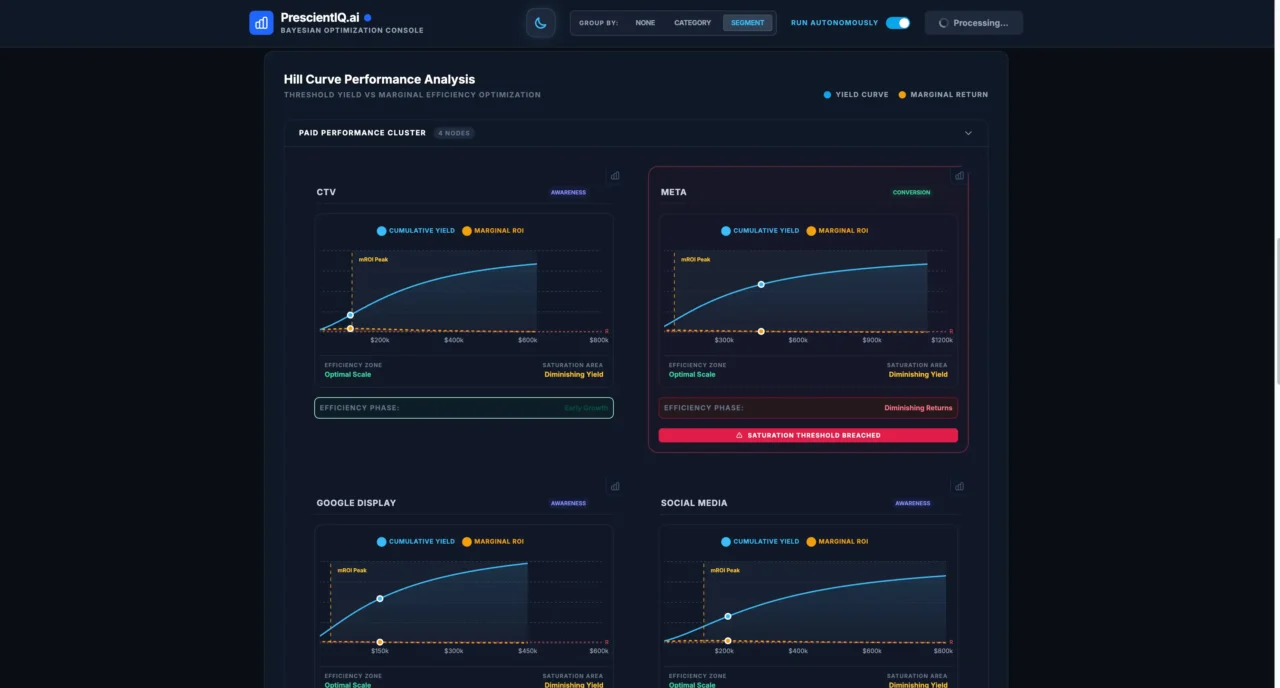
Causal AI moves beyond standard predictive analytics to determine the true, incremental impact of marketing actions. Here are three critical applications for RevOps leaders:
1. Budget Allocation Optimization (Incremental Lift Modeling)
This application directly addresses the “Selection Bias Trap” by quantifying the true revenue generated by each channel, net of baseline demand.
- Goal: Maximize incremental revenue by shifting budget away from channels that merely “tax” existing demand and toward channels that create a net-new pipeline.
- Mechanism: The system performs counterfactual analysis, asking: “If we increased spending on this channel by $X, what would the resulting additional pipeline be, considering the current natural demand baseline?” It then ranks channels by their Marginal Causal Return on Ad Spend (M-C-ROAS).
- RevOps Outcome: Provides a data-driven mandate for budget reallocation, proving to the CFO that every dollar is spent on activities that genuinely expand the market, not just capture existing interest.
2. Content and Offer Effectiveness (Shadow Funnel Decode)
Causal AI helps decode the “Shadow Funnel” by determining which content touchpoints—even those in dark social or private channels—truly advance a prospect toward a conversion.
- Goal: Identify the specific piece of content (e.g., a high-gated report, a specific webinar, or a dark social mention) that acts as the trigger for a subsequent trackable conversion.
- Mechanism: The system analyzes the sequence of events leading to conversion, filtering out common, non-causal touchpoints (like simple homepage visits) to isolate the influential content. It can identify patterns like “Buyers who consumed X piece of content are 3x more likely to convert from an ad click 7 days later.”
- RevOps Outcome: Directs content strategy and creation efforts toward high-leverage assets that accelerate the buying journey, rather than just generating awareness that goes nowhere.
3. Churn Prevention and Upsell Prediction (Intervention Modeling)
For existing customers, Causal AI can predict not just who will churnbut also why, and precisely which intervention will prevent it.
- Goal: Proactively deploy the most effective, least-costly intervention (e.g., a dedicated support call, a specific product update email, or a retention-focused discount) to prevent customer attrition.
- Mechanism: The system models the causal link between customer behavior (e.g., product usage decrease, support ticket frequency) and the eventual churn event. It then performs a counterfactual simulation: “If we execute Intervention A, what is the causal reduction in the probability of churn, compared to doing nothing?”
- RevOps Outcome: Transforms Customer Success from a reactive service into a proactive revenue driver, optimizing the Net Revenue Retention (NRR) metric by applying the right fix at the right time.
Conclusion: Key Learning Points
The Path Forward: Embracing Causal Truth
The shift from traditional, correlation-based attribution to Causal AI is not merely a technical upgrade; it’s a fundamental change in how RevOps justifies its existence.
For too long, marketing has operated under the generous illusion of “attribution credit,” masking inefficiency and allowing significant budget to flow into channels that merely tax existing demand.
The multi-billion dollar mirage ends when the CFO demands proof that advertising spend is generating truly incremental revenue—sales that would not have occurred otherwise. Moving forward, RevOps leaders must champion the Causal Index as the single source of truth, abandoning vanity metrics in favor of counterfactual evidence of ROI.
Summary: Signal vs. Noise
The core challenge for any B2B marketing organization is isolating the Signal (true incremental growth) from the Noise (natural market demand, brand equity, and spurious correlations).
Traditional tech stacks fail at this because they are designed to track every touchpoint rather than question their necessity.
By acknowledging the reality of the Shadow Funnel and the pervasive nature of Selection Bias, teams can stop rewarding channels for converting high-intent users and start investing in strategies that genuinely expand the pipeline. Are your LinkedIn Ads Driving Revenue, or Taking Credit for Organic Growth?
This deliberate filtering process ensures every dollar spent contributes to net-new growth.
Final Takeaway for RevOps Leaders
To earn leadership’s trust, RevOps must shift from descriptive reporting (“What happened?”) to prescriptive action (“What should we change?”).
The Causal Audit is the tool for this transition. By establishing a clear baseline of natural demand and calculating the true incremental lift—the Causal Index—you can confidently identify and eliminate waste spend.
The 15-minute audit is an immediate, actionable step toward becoming a truly autonomous revenue marketing organization, demonstrating that your campaigns are not just taking credit but actively driving profitable growth.
- The Counterfactual is Key: You cannot prove ROI without knowing what would have happened if you spent nothing.
- Isolate the Signal: Use Causal AI to filter out external market noise from internal performance.
- Next Steps: Perform a 7-day “spend freeze” on a single low-performing campaign to measure its true incremental impact.
- Are your LinkedIn Ads Driving Revenue, or Taking Credit for Organic Growth?
Is Your Competitor’s AI Smarter Than Yours?
You have the data. They have the insights. Find out exactly where your digital infrastructure is leaking revenue. Knowing your maturity score is step one. Fixing the bottlenecks is step two. Don’t let your data sit idle while you figure out the “how.”
FAQ: People Also Ask
How does Causal AI improve RevOps efficiency?
Causal AI identifies “Waste Spend” by highlighting channels that claim credit for natural market demand. This allows RevOps to reallocate budget to channels with the highest incremental lift.
What is the difference between correlation and causation?
Correlation means two events occur together. Causation establishes that one event directly caused the other.