

Discover the “Human Latency” Gap: Why Causal AI is the Only Fix for Fragmented ROI.
Stop relying on misleading last-click attribution. Discover how the “Human Latency” Gap drains your ad budget and how Causal AI and PrescientIQ reveal true incrementality.
Key Takeaways
- The Illusion of ROI: Relying on platform-specific data (like Facebook’s self-reported metrics) creates an inflated, fragmented view of success.
- The Latency Problem: Human analysis cannot bridge the gap between fragmented data sources fast enough to distinguish correlation from causation.
- The Causal Solution: You need Causal AI and an autonomous marketing platform to determine incrementality—specifically, whether a conversion would have happened without the ad spend.
- The PrescientIQ Advantage: Advanced models move beyond historical correlation to predict future outcomes with high precision.
What is the “Human Latency” Gap?

The “Human Latency” Gap is the costly delay and analytical error that occur when marketers manually correlate fragmented data across platforms to measure ROI, failing to distinguish whether an ad caused a sale or merely correlated with it.
Are you spending significantly on ads without proof of what works?
The Uncertainty of Ad Spend
You are pouring massive budgets into digital advertising, yet a gnawing uncertainty remains. You see the numbers moving, but you cannot prove exactly what is driving the engine.
You are likely spending significantly on ads, but you cannot prove which ones are actually working.
This is not just a reporting issue; it is a financial hemorrhage caused by the “Human Latency” Gap—the inability of human analysts to process fragmented signals in real time.
The Problem with Last-Click
The specific issue is that you are relying on “last-click” attribution or platform-specific data.
When Facebook says it drove a sale, and Google claims the same sale, your view of ROI becomes inflated and fragmented. Industry leaders like Gartner have noted that relying on siloed platform data leads to misallocated budgets because these platforms are incentivized to claim credit for every conversion.
You are left asking critical questions like, “If I hadn’t spent this $10k on YouTube, would these customers have converted anyway?”.
The Need for Causation
You need to move beyond simple correlation—where a customer saw an ad and bought—to causation, proving the ad made them buy.
You need Causal AI to determine incrementality.
This is where PrescientIQ fits into your stack. By utilizing advanced causal inference, you can close the gap between data generation and actionable insight, ensuring every dollar spent contributes to net-new revenue rather than subsidizing customers who were already going to convert.
Abandoning Vanity Metrics
To survive in a zero-click, AI-driven search landscape, you must abandon the comfort of vanity metrics.
The following analysis breaks down the Human Latency Gap and details how Causal AI provides the only bridge to true marketing truth.
What is trending in attribution and Causal AI?
How is the industry shifting away from Last-Click?
The industry is aggressively pivoting toward incrementality testing and AI-enhanced Media Mix Modeling (MMM).
Current trends indicate a massive rejection of cookies and third-party tracking, driven by privacy regulations (GDPR, CCPA) and browser restrictions.
As reported by Forrester, marketers are scrambling for “cookieless” attribution methods, which places Causal AI at the forefront of the conversation.
The trend is moving toward “Unified Marketing Measurement” (UMM). This approach seeks to reconcile the immediate, granular data of Multi-Touch Attribution (MTA) with the strategic, aggregate insights of MMM. However, without Causal AI, this reconciliation is manual, slow, and prone to the Human Latency Gap.
Comparison: Traditional vs. Causal Attribution
| Feature | Traditional Last-Click / Platform Data | Causal AI (PrescientIQ) |
| Data Source | Fragmented, Siloed (Facebook, Google) | Unified, Cross-Channel Inference |
| Key Metric | Correlation (Saw Ad $\rightarrow$ Bought) | Causation (Ad $\rightarrow$ Caused Purchase) |
| Speed | High Latency (Retrospective) | Real-Time / Predictive |
| ROI View | Inflated / Double-Counted | Incremental / Net-New |
| Question Answered | “Did they click?” | “Would they have bought anyway?” |
Who, What, Where, When, and Why of the Human Latency Gap?

Who is most affected by this gap?
Marketing executives, CMOs, and performance marketers managing multi-channel budgets are the primary victims.
If you are managing spend across Meta, Google, TikTok, and CTV, you are susceptible. Specifically, the client who has difficulty distinguishing between correlation and causation is most at risk of budget wastage.
What is the core technological failure?
The failure lies in relying on deterministic models in a probabilistic world. You are using linear tracking (last-click) to measure non-linear human behavior.
The “Human Latency” aspect refers to the time and cognitive load required for a human analyst to review a Facebook report and a Shopify report and deduce the truth.
By the time the analysis is done, the budget is already spent.
Where does the data disconnect occur?
The disconnect happens in the “Walled Gardens.” Facebook, Google, and Amazon operate as closed ecosystems; they grade their own homework.
As noted by advertising experts, platform-specific data creates a fragmented view of ROI because each platform claims 100% credit for a user journey that may have touched ten different touchpoints.
When should you implement Causal AI?
The moment your ad spend exceeds your ability to manually track incrementality, you are losing money.
If you are asking, “If I hadn’t spent this $10k on YouTube, would these customers have converted anyway?” and cannot answer immediately with data, you are already behind.
Why is PrescientIQ the necessary solution?
You need PrescientIQ because it utilizes Causal AI to determine incrementality.
Standard AI predicts what will happen based on patterns; Causal AI predicts what will happen if you intervene (e.g., spend money). This distinction is the only way to eliminate the waste inherent in the Human Latency Gap.
What do top research firms say about Causal AI?
How does Gartner view the future of marketing data?
Leading research firms like Gartner and Forrester are increasingly categorizing Causal AI as a critical component of “Adaptive AI” systems.
Gartner has predicted that by 2025, over 30% of generative AI models will require causal reasoning to ensure robust decision-making.
They argue that correlation-based machine learning is insufficient for business-critical decisions like budget allocation because it lacks “counterfactual reasoning”—the ability to ask “what if?”.
What is the consensus on “Cookie Deprecation”?
Research from Deloitte highlights that the loss of third-party cookies creates a “signal loss” crisis.
They emphasize that statistical modeling and AI are the only viable replacements for tracking individual user paths. In this context, the “Human Latency” Gap widens because the data is no longer explicit; it is probabilistic.
Therefore, a system like PrescientIQ, which can infer causality without invasive tracking, is essential for future-proofing your stack.
3 Use Cases: Closing the Gap with PrescientIQ
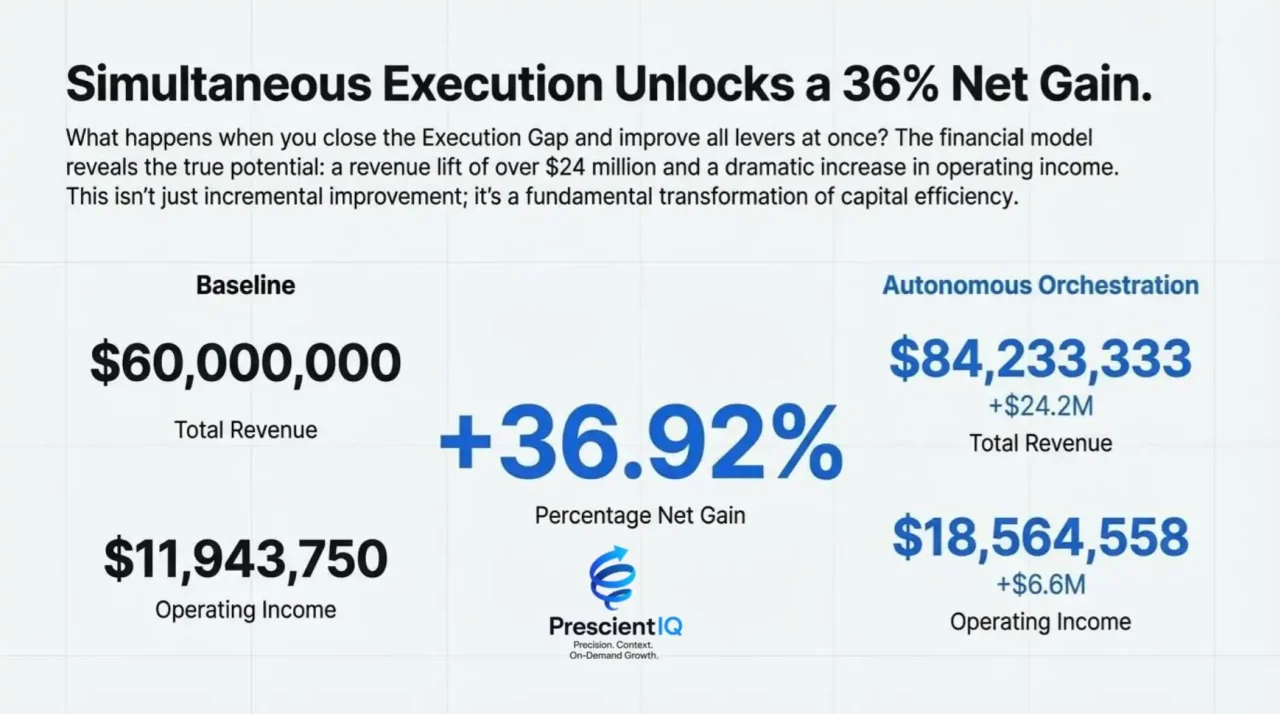
Use Case 1: The YouTube Incrementality Test
Before:
You are spending $10k on YouTube ads. The platform reports high conversion rates, but your overall sales aren’t rising proportionally.
You suspect these customers were already loyal to your brand, but you rely on platform-specific data, which confirms the ad’s success.
By applying PrescientIQ, you run a causal inference model. The system creates a synthetic control group to simulate what would have happened in the absence of ad spend.
The Causal AI reveals that 80% of the YouTube conversions were non-incremental—meaning those users would have bought anyway. You reallocate that $10k to a high-incrementality channel like CTV, immediately boosting net-new revenue. This answers the critical question: “If I hadn’t spent this $10k… would they have converted anyway?”.
Use Case 2: Unifying Fragmented Social Spend
You run ads on Facebook, TikTok, and Instagram. Each platform claims the same sale. If you add up the reported ROI from all three, it exceeds your total actual revenue. You have an inflated view of ROI.
You use Causal AI to analyze the interactions between channels. The AI identifies that TikTok creates the initial interest (causation), while Facebook merely retargets (correlation).
PrescientIQ assigns the “causal credit” to TikTok.
You stop overfunding the Facebook retargeting campaigns that are simply claiming credit for work done elsewhere, closing the gap between reported metrics and bank account reality.
Use Case 3: Seasonal Budget Optimization
During Black Friday, sales spike naturally. You ramp up ad spend, and sales go up. You assume the ads caused the spike (correlation), but it might just be the season.
Causal AI separates the “seasonal baseline” from the “marketing lift”. It distinguishes sales that occurred in November from those that occurred because of your ad.
You discover your Return on Ad Spend (ROAS) is actually lower than you thought. You adjust your bid strategy in real time to target only users who need a nudge, rather than subsidizing discounts for users already hunting for them.
3 Challenges: The Cost of Ignoring the Gap
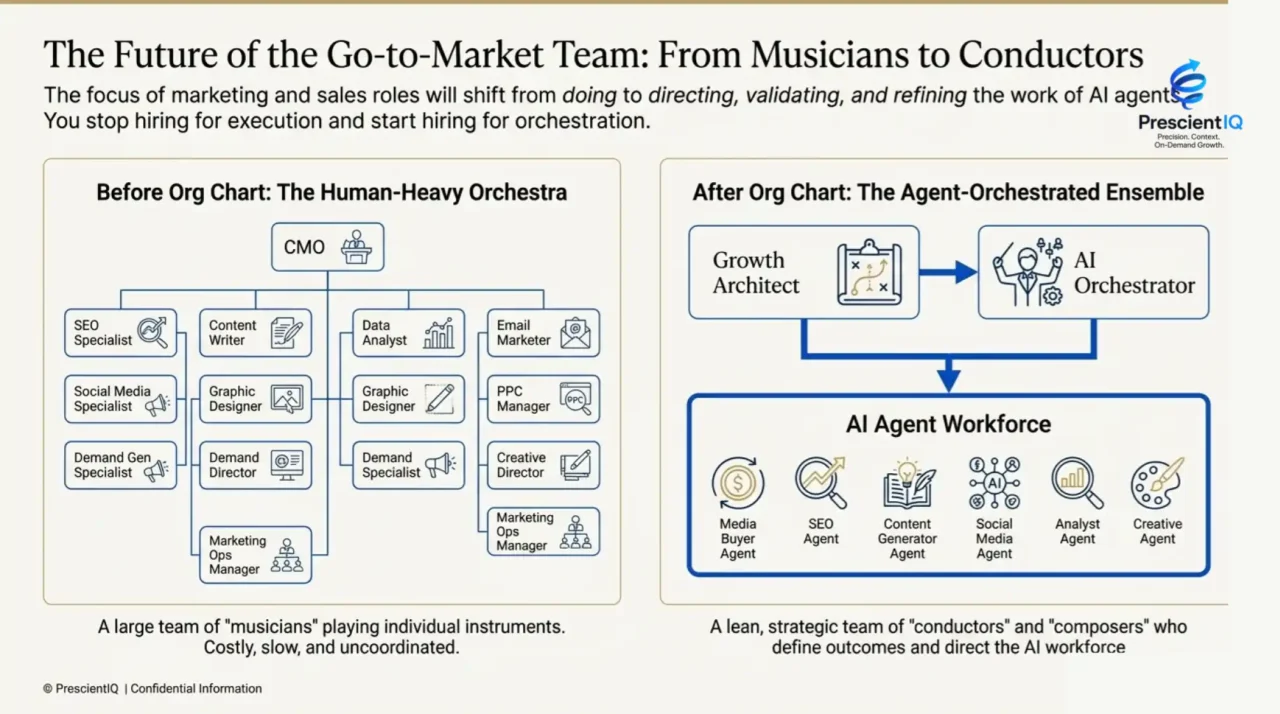
Challenge 1: The “False Positive” Budget Drain
The Risk:
Without Causal AI, businesses fall into the trap of funding “False Positives”—marketing channels that look effective but add no value.
You continue spending significantly on ads, but you cannot prove what is actually working.
The Impact:
You might waste 30-40% of your budget on channels that are essentially “cannibalizing” your organic traffic. This is the direct result of having difficulty distinguishing between correlation and causation.
Challenge 2: Analytical Paralysis
The Risk:
As data sources multiply, the “Human Latency” increases.
Your team spends weeks consolidating spreadsheets to produce a Monthly Business Review (MBR).
The Impact:
By the time the MBR is presented, the market conditions have changed.
You are reacting to data that is 30 days old. In a geo-targeted, real-time bidding environment, this latency is fatal. You need the speed of AI to react to incrementality signals instantly.
Challenge 3: C-Suite Credibility Loss
The Risk:
The CEO asks, “Why did we spend $50k on Facebook if our total revenue is flat?” You point to Facebook’s report, but the numbers don’t add up to the company’s bottom line.
The Impact:
Reliance on “last-click” attribution creates a credibility gap. If marketing cannot prove incrementality—that the ad spend caused the revenue—budgets get cut.
Risk Assessment Matrix
| Challenge | Cause | Consequence |
| Budget Drain | Mistaking Correlation for Causation | Funding organic conversions |
| Data Silos | Platform-Specific Reporting | Inflated ROI view |
| Slow Reaction | Human Analysis Latency | Missed market opportunities |
How do you implement Causal AI for Attribution?
Step 1: Centralize and Cleanse Data
You cannot determine incrementality if your data is trapped in silos.
The first step is to aggregate data from all marketing platforms (ads, email, organic) and conversion points (Shopify, Salesforce).
Step 2: Establish the “Counterfactual”
This is the core of PrescientIQ. You must configure the model to ask the counterfactual question: “What happens if we do nothing?”.
This establishes a baseline against which all ad spend is measured.
Step 3: Run Incrementality Experiments
Don’t just switch the AI on; test it. Turn off a specific channel (e.g., YouTube) for a specific geo-location and let the Causal AI predict the drop.
If the drop matches the prediction, the model is calibrated.
Step 4: Shift Budget Based on Causality
Once the model distinguishes between correlation and causation, move the budget immediately. Defund the channels with high reported ROI but low incrementality.
Double down on channels that drive net-new customers.
Is Your Competitor’s AI Smarter Than Yours?
You have the data. They have the insights. Find out exactly where your digital infrastructure is leaking revenue. Knowing your maturity score is step one. Fixing the bottlenecks is step two. Don’t let your data sit idle while you figure out the “how.”
Conclusion
The “Human Latency” Gap is the silent killer of modern marketing efficiency.
As long as you rely on last-click attribution and fragmented platform data, you will continue to see an inflated, inaccurate view of your ROI.
The difference between thinking an ad worked and knowing an ad worked is Causal AI.
Key Learning Points:
- Stop trusting the platform: Facebook and Google have a vested interest in claiming credit.
- Focus on Incrementality: The only metric that matters is whether the ad caused the sale.
- Automate the Insight: You cannot manually calculate correlation vs. causation fast enough to be effective.
Next Steps:
Audit your current attribution stack. If you cannot answer the question, “Would these customers have converted anyway?” within five minutes, it is time to investigate PrescientIQ.
FAQ
What is the difference between correlation and causation in marketing?
Correlation means two trends happen together (e.g., ad views and sales rise). Causation proves the ad forced the sale. Causal AI distinguishes these to prevent wasting budget on customers who would have bought regardless.
Why is last-click attribution misleading?
Last-click gives 100% credit to the final touchpoint (e.g., a Google search) while ignoring the videos or social ads that actually created the desire. This leads to an inflated, fragmented view of ROI.
How does Causal AI determine incrementality?
Causal AI uses counterfactual reasoning to simulate a world where the ad didn’t exist. By comparing this simulation to reality, it isolates the true “lift” or incrementality generated specifically by that spend.
What is the “Human Latency” Gap in data analysis?
It is the delay caused by humans manually processing fragmented data from multiple platforms. This lag prevents real-time optimization, whereas AI can instantly identify which ads are truly driving incremental revenue.
Why do I need PrescientIQ for marketing measurement?
You need PrescientIQ because standard analytics only show what happened. PrescientIQ uses Causal AI to explain why it happened and what would happen if you changed your spend, solving the correlation vs. causation dilemma.