

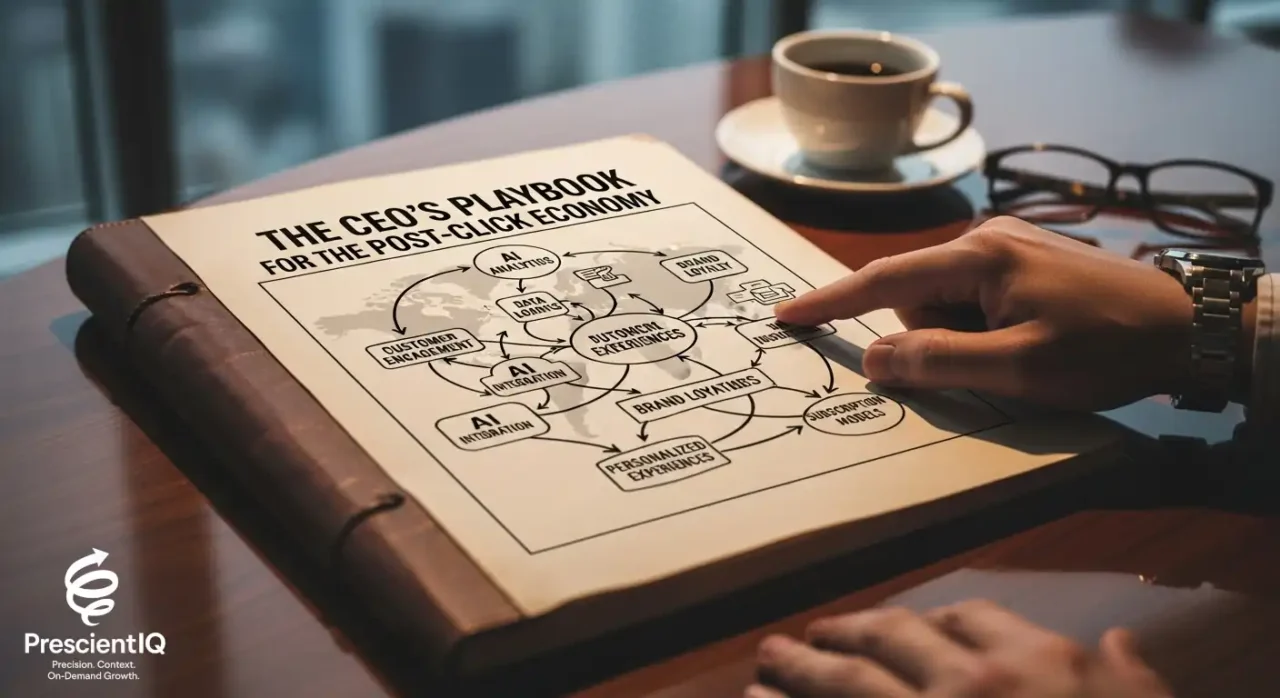
The CEO’s Playbook for the Post-Click Economy: Architecting Dominance in the Age of AI Search
The CEO’s Playbook for the Post-Click Economy: Architecting Dominance in the Age of AI Search
Executive Summary in the Age of AI Search
For the last two decades, the digital economy has operated on a single, dominant currency: the “Click.”
The architectural blueprint of the commercial internet was designed around search bars, keywords, and lists of blue links.
Corporations invested billions optimizing for this model, measuring success by traffic volume, sessions, and click-through rates.
That era is effectively over.
We are currently witnessing a tectonic shift in digital engagement that renders traditional Search Engine Optimization (SEO) strategies increasingly obsolete. With the rise of Generative AI, we are moving from a search economy to an answer economy.
Market analysis predicts a 25% decline in traditional search traffic by 2026 due to the rise of AI-driven answer engines.
Furthermore, nearly 60% of searches in major markets are already “zero-click,” meaning users find their answers on the results page without ever visiting a corporate website.
This creates a critical strategic imperative for the C-Suite.
The goal is no longer to be found in a list; the goal is to be the singular answer cited by the machine. If your content isn’t the direct answer, it risks going unnoticed.
This guide outlines the transition to Answer Engine Optimization (AEO) and Generative Engine Optimization (GEO), the required restructuring of your marketing leadership, and the specific strategies required to rank within the “black box” of Large Language Models (LLMs).
Part I: The Collapse of the “Blue Link” Paradigm
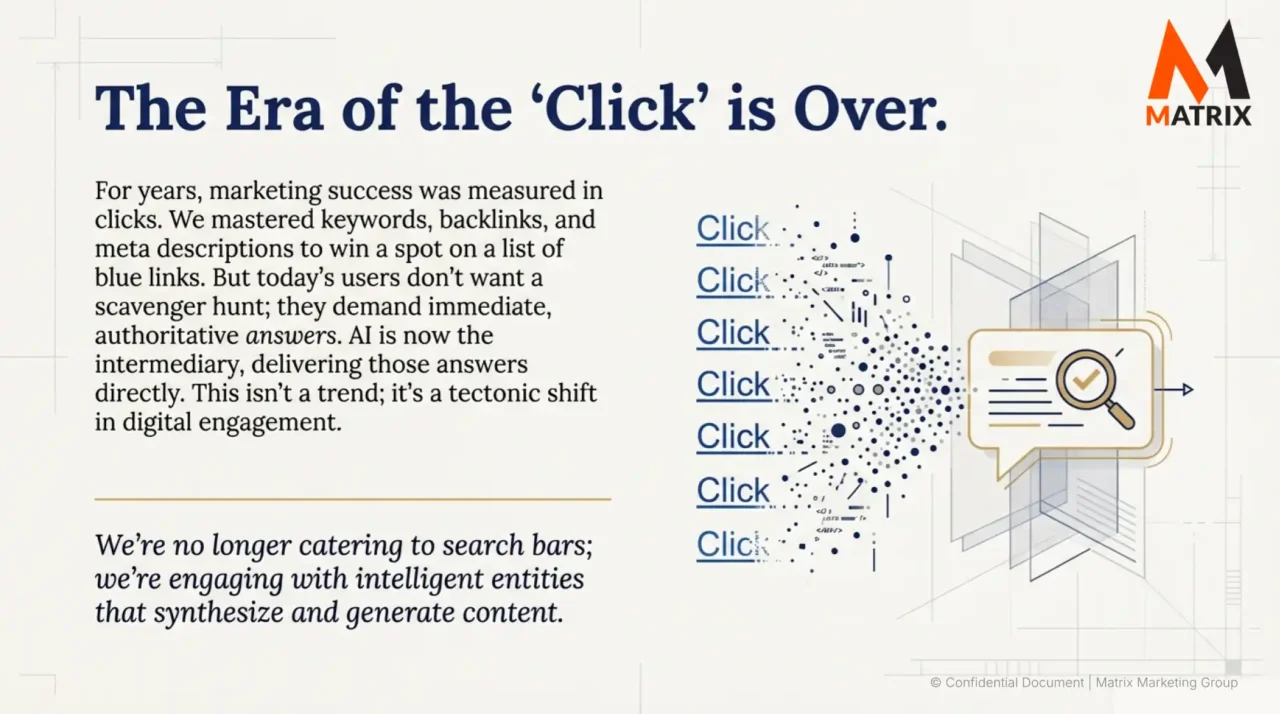
The Death of the Scavenger Hunt
Historically, search engines functioned as intermediaries that presented users with a “scavenger hunt” of blue links.
The burden was on the user to click, read, synthesize, and extract value. Today, users demand immediacy.
They are no longer catering to search bars; they are engaging with intelligent entities that synthesize and generate content directly.
AI has evolved from a tool that finds information to an intermediary that delivers the answer.
The Financial Risk of Inaction
The decline of the “click” is not merely a marketing trend; it represents a fundamental migration of potential revenue.
- The Zero-Click Reality: With the majority of searches ending without a click, traditional traffic metrics are becoming “vanity metrics” that no longer correlate with revenue.
- The Invisible Brand: As AI Overviews and chatbots become the primary interface for information, brands that fail to optimize for these platforms will disappear from the customer’s consideration set during the critical discovery phase.
- The “Black Box” Threat: Traditional marketing agencies often operate as “black boxes,” obscuring the “why” behind performance. In an era where AI algorithms are opaque, relying on an opaque partner is a double liability.
Part II: The New Twin Pillars of Growth—AEO & GEO
To survive the “Vanishing Click,” organizations must pivot to two new disciplines: Answer Engine Optimization (AEO) and Generative Engine Optimization (GEO). While related, they serve different functions and require distinct strategies.
1. AEO (Answer Engine Optimization): Being the Fact
AEO is about structuring your enterprise data to be the definitive, go-to information source for AI Overviews, featured snippets, and voice search (e.g., Siri, Alexa).
- The Objective: To be the direct answer.
- The Mechanism: Structuring information so it is easily digestible by both humans and AI. This involves crafting clear, comprehensive FAQs and implementing structured data (schema markup).
- Strategic Value: Crucial for industries where accuracy and immediacy are paramount, such as Healthcare, Legal, and Local Business. AEO establishes your brand as the “truth” in the algorithm’s eyes.
2. GEO (Generative Engine Optimization): Influencing the Narrative
If AEO is about facts, GEO is about influence.
GEO focuses on creating deep, authoritative content that Generative AI models (like ChatGPT, Gemini, and Claude) synthesize, cite, and use to construct their responses.
- The Objective: To shape the AI’s foundational understanding of your industry and brand.
- The Mechanism: Creating high-quality, authoritative content with unique insights and utilizing multimodal formats (text, images, video).
- Strategic Value: This is critical for E-commerce, B2B, and Publishing. GEO ensures that when an AI “thinks” about a problem your company solves, your brand is woven into the solution narrative.
Part III: The Strategy to Rank on LLMs and AI Search
Ranking in a generative world is fundamentally different from ranking in a keyword world. AI models do not just “index” content; they “understand” it.
To ensure LLMs and AI Overviews cite your brand, you must implement the following four-part strategy.
1. Format for Machine Comprehension (The “Q&A” Pivot)
LLMs are trained on vast datasets, but they prioritize content that clearly answers user intent. Follow these in the Age of AI Search.
- The Strategy: You must pivot your content architecture from long-form “keyword stuffing” to concise “Question & Answer” blocks.
- Execution: Audit your top 20 revenue-driving products or services. Create specific, authoritative FAQ sections that directly address the “Who, What, Where, When, and Why” of those topics. Use natural, conversational language that mirrors how a user would speak to a smart assistant.
- The Goal: Make it effortless for the AI to extract your specific paragraph as the “correct” answer to a user query.
2. Implement “Digital Labeling” (Schema Markup)
AI is smart, but it still needs guidance. Structured data (schema markup) acts as a digital label that tells the AI exactly what your content is—whether it’s a product, an event, a recipe, or a corporate biography.
- The Strategy: Implement robust schema markup across your entire digital footprint.
- Execution: Do not just tag the basics. Use an advanced schema to define your brand’s relationship to specific industry concepts. This helps build a “Knowledge Graph” that the AI relies on for accuracy.
- The Goal: Remove ambiguity. When the AI is 100% sure your data is accurate, it is exponentially more likely to cite you as the authority.
3. E-E-A-T as the Ranking Algorithm
For AI, “trust” is the new SEO. Google and other AI providers rely heavily on E-E-A-T (Experience, Expertise, Authoritativeness, and Trustworthiness) to determine which content is safe to present to users.
- The Strategy: Your content must be authored by verifiable experts and cited by other authoritative sources.
- Execution: Ensure all high-value content has clear author bylines with credentials. Publish unique, primary research and data that cannot be found elsewhere. The AI models prioritize “information gain”—new information that adds to the conversation rather than just repeating it.
- The Goal: Position your brand as a “seed source” of information that the AI must reference to be complete.
4. Feed the “Multimodal” Beast for Better AI Search
Modern LLMs are not text-only; they process images, video, and audio.
- The Strategy: Diversify your content assets.
- Execution: Surround your text answers with relevant infographics, explanatory videos, and clean imagery. Optimize the file names and alt text for these assets with the same rigor used for text.
- The Goal: Capture visibility in visual search results and give the AI more context clues about your relevance.
Part IV: The Restructuring of Marketing Leadership
The shift to AEO and GEO requires more than new tools; it requires a new job description for your marketing leadership.
The modern marketing leader must evolve into a hybrid technologist-strategist.
There are five specific roles your CMO and marketing VPs must now inhabit. And watch out for the digital autonomous workers.
1. The Content Transformer
The days of “writing for SEO” are over. Leaders must now reimagine content for AI consumption. This means content must be structured, clear, and conversational to align with Natural Language Processing (NLP) capabilities.
2. The ROI Detective and the Age of AI Search
In a “zero-click” world, traffic charts are misleading. Marketing leaders must find new ways to measure ROI beyond traditional sessions and pageviews. They must measure “share of answer” and brand authority within AI responses.
3. The Algorithm Whisperer
AI models change largely without warning. Your leadership must constantly decode algorithm updates and adapt strategies in real-time. This requires a proactive, rather than reactive, stance toward technical changes in search infrastructure.
4. The Brand Authority Builder
Leaders must focus purely on credibility to ensure AI trusts and cites the brand as a reliable source. This involves PR, verified data publication, and academic-level citation strategies.
5. The Data Architect
Successful AI deployment runs on data. Marketing leadership must now integrate and leverage vast amounts of proprietary data to fuel effective AI applications and train the models on your brand’s unique value proposition.
Part V: The “Glass Box” Operational Model

The most significant change required is in how your organization partners with external agencies. The traditional agency model—characterized by opaque retainers, vanity metrics, and “black box” methodologies—is obsolete in this new environment.
Rejecting the “Black Box”
You cannot optimize what you cannot see.
Many agencies operate as “black boxes,” obscuring the “why” behind performance to maintain dependency.
In the AEO/GEO paradigm, this is a liability. You need total transparency to build a defensible advantage.
Embracing the “Glass Box” Philosophy
Your organization should demand a “Glass Box” partnership. This implies:
- Intellectual Property Ownership: Clients must understand the “why” behind performance and own their marketing intelligence. You should know exactly what prompts, schemas, and content strategies are driving your results.
- Performance-Based Pricing: Compensation should be tied to measurable results—Cost Per Lead (CPL), Cost Per Acquisition (CPA), or Revenue Share. The partner should only win when you win.
- Unified AI Ecosystems: Moving away from fragmented tools to a “Rainforest” model that integrates Strategy, Talent, Tech, and Data into a unified powerhouse.
Part VI: The Technology of Authority
Executing AEO and GEO strategies at an enterprise scale is impossible without the right technical infrastructure. You cannot manually optimize thousands of pages for AI.
The following applications represent the modern “AI Arsenal” required to master this transition.
1. High-Velocity Content Synthesis
To dominate AI answers, you need content velocity and structure.
Tools are required that can dramatically increase content production while ensuring assets are authoritative and structured for AI comprehension.
This solves the “volume vs. quality” paradox.
2. Share of Voice Measurement
You need to solve the “zero-click ROI” problem.
This requires dashboards that track your brand’s “share of voice” in AI responses, measuring answer accuracy and AI authority.
This data shows exactly how your AEO/GEO efforts are performing, even if no click occurs.
3. Predictive Intent Modeling
To win the answer, you must predict the question. AI-powered analytics are essential for identifying high-value prospects and understanding user intent with precision.
This ensures your content is perfectly aligned with specific needs, driving engagement even in AI-mediated experiences.
Part VII: Real-World Business Impact
The transition to AEO and GEO is not theoretical; it is already driving divergent outcomes in the market.
Case Study: B2B SaaS and the Age of AI Search
A fast-growing B2B SaaS company found itself invisible in Google AI Overviews for key solution queries.
By deploying AEO strategies—specifically restructuring deep-dive content into concise Q&A blocks with schema markup—they achieved a 40% increase in AI citation frequency within 6 months.
More importantly, this led to a 15% reduction in Customer Acquisition Cost (CAC).
Case Study: Global E-commerce
A global retailer was missing from generative AI product recommendations during the discovery phase.
By implementing GEO strategies to influence AI narrative construction, they saw a 1.5x increase in AI-Attributed Revenue Share and a 30% reduction in cart abandonment rates.
This proves that properly informing the AI leads to more “conversion-ready” customers reaching the checkout.
Conclusion: Architect, Don’t Just Adapt – The Age of AI Search
The era of the “Click” provided a comfortable, predictable metric for business success. That era is over.
As we look around the corner, we see hyper-personalization delivered by AI and a digital landscape where Experience, Expertise, Authoritativeness, and Trustworthiness are the primary ranking factors.
To win in this environment, you must:
- Be the Answer: Structure content for AI consumption, not just human reading.
- Influence the Narrative: Optimize to be the trusted source that Generative AI wants to cite.
- Demand Transparency: Partner with providers who offer “glass box” visibility and tie compensation to performance.
The future of search is not about finding; it is about knowing. Keep learning about the Age of AI search.
The organizations that architect their content and data for this new reality will not just survive the death of the click—they will own the answer.
Stop getting your AI budget cut: Move beyond “efficiency” to provable P&L impact.
Core Concept: Visually contrast the failed “efficiency-only” pitch (which collapses into a Strategic Value Black Hole) with a 4D Value Framework that ties AI to revenue, pipeline, enterprise value, and risk reduction.
The Strategic Value Black Hole
Cost-only logic collapses your business case. Efficiency ≠ investment thesis.
A 5% boost in “Lead Scoring Accuracy” = $12M in Qualified Pipeline.
Tie model accuracy to increased Sales-Accepted Leads and win-rate lift.
A 10% lift in “Cross-Sell Conversion” from AI = $45M in New Revenue.
Translate conversion lift into additional orders, margins, and P&L impact.
A 20% increase in “Customer Lifetime Value (CLV)” from AI-personalization = $100M in Enterprise Value.
Convert CLV gains into discounted cash flows the CFO recognizes.
AI-driven compliance in ad-targeting = $8M in Fines Avoided.
Model compliance avoidance as preserved operating income.