
Discover how Vertical Agentic Customer Platforms are revolutionizing the future of MarTech. Learn why agentic AI, integrated with Customer Data Platforms (CDPs), is the key to autonomous marketing execution, real-time personalization, and superior ROI in 2026.
PrescientIQ moved the cheese from a “Systems of Record” to “Systems of Action.”
What is a Vertical Agentic Customer Platform?
Traditional Vertical SaaS (Software-as-a-Service) provides the tools and dashboards that humans use to help with work. A Vertical Agentic Customer Platform represents a shift from efficiency to judgment: instead of humans operating the software, AI agents “partner” with humans to execute work directly based on set goals. PrescientIQ is an AI-native foundation with agentic systems, vs the legacy field, which moves from “Systems of Record.” We use a “Systems of Action.”
Executive Summary: The Shift to Agentic MarTech
What is a Vertical Agentic Customer Platform? A Vertical Agentic Customer Platform is an AI-driven ecosystem that combines data ingestion from a CDP with autonomous “agents” that can make decisions and execute tasks without human intervention.
Unlike traditional CDPs that merely store and segment data, agentic platforms use generative intelligence to predict customer needs, orchestrate multi-channel journeys, and optimize spend in real-time. This shift represents a move from passive data management to active, autonomous marketing operations.
What is The Future of MarTech: Why Vertical Agentic Customer Platforms

A Vertical Agentic Customer Platform is a specialized software architecture that integrates Autonomous Agents—AI entities capable of reasoning and taking action—directly into the data layer of an industry-specific Customer Data Platform (CDP).
In traditional marketing stacks, a CDP serves as a “brain” that remembers everything but lacks “hands” to do the work. You might know a customer is likely to churn, but a human marketer must still design the email, set the trigger, and approve the discount.
In contrast, an Agentic Platform perceives the data, reasons through the best objective (e.g., “Retain this high-value customer”), and executes the necessary actions across your tech stack automatically.
Data suggests that integrating AI into these systems is no longer optional. Agentic AI is responsible for 60% of the value AI generates in marketing and sales, according to McKinsey.
By focusing on “vertical” applications—meaning the AI is pre-trained on specific industry nuances like healthcare regulations or retail inventory cycles—these platforms offer higher precision than general-purpose LLMs.
How does an Agentic Platform differ from a traditional CDP?
The primary difference between an Agentic Platform and a traditional CDP is the transition from Deterministic Rules to Autonomous Reasoning. While a CDP relies on “If-This-Then-That” logic set by humans, an Agentic Platform uses goal-oriented reasoning to determine the best path forward based on real-time environmental changes.
| Feature | Traditional CDP | Vertical Agentic Customer Platform |
| Data Role | Storage and Segmentation | Context for Autonomous Action |
| Decision Making | Human-defined rules | AI Goal-seeking & Reasoning |
| Execution | Manual or API Triggers | End-to-end Autonomous Execution |
| Learning | Static Analysis | Continuous Self-Optimization |
| Verticality | General Data Schema | Industry-specific Ontologies |
80 percent of conversational offerings will be replaced by agentic AI that manages the entire customer lifecycle, according to Gartner. This evolution means your MarTech stack is moving from a toolset you use to a workforce that works for you.

Why are Information Gain and Entity Salience vital for AI Search?
Information Gain refers to the unique, non-derivative value a piece of content provides compared to what is already indexed, while Entity Salience is the clarity with which a brand or concept is positioned as a primary topic. For Generative Engine Optimization (GEO), these factors are critical because AI models like Search Generative Experience (SGE) prioritize content that provides new data points or clear, authoritative definitions.
To rank in Zero-Click searches, you must move beyond generic keywords. You need to define the relationships between entities.
For instance, explaining how a Vector Database (the memory) interacts with an LLM (the reasoning engine) to power a Marketing Agent (the actor) provides the “Technical Signal” that search engines crave.
Core Differences: Passive Storage vs. Active Agency
| Feature | Traditional CDP | Vertical Agentic Customer Platform |
| Data Role | Storage and Segmentation | Context for Autonomous Action |
| Decision Making | Human-defined rules | AI Goal-seeking & Reasoning |
| Execution | Manual or API Triggers | End-to-end Autonomous Execution |
| Learning | Static Analysis | Continuous Self-Optimization |
| Verticality | General Data Schema | Industry-specific Ontologies |
What are the core components of an Agentic MarTech architecture?
The architecture of a Vertical Agentic Customer Platform consists of four distinct layers: Data Ingestion, Cognitive Reasoning, Tool Use (Action), and Feedback Loops.
- Unified Data Layer (The Memory): This is the evolved CDP. It gathers first-party data, but stores it in a way that AI can understand, often using Vector Embeddings.
- Agentic Orchestration (The Brain): This layer uses models like GPT-4o or specialized vertical models to “think.” It breaks down complex marketing goals into smaller sub-tasks.
- Action Adapters (The Hands): These are integrations with your email tools, social platforms, and CRM. The agent “uses” these tools just like a human would.
- Guardrails (The Ethics): A critical component that ensures the AI stays within brand voice and budget constraints.
“The move toward agentic workflows is the single most important trend in AI for the coming year,” stated Andrew Ng during a recent industry keynote. This sentiment underscores why businesses are rushing to move their data out of “dumb” siloes and into agentic environments. The Future of MarTech: Why Vertical Agentic Customer Platforms is deep breadth and depth.
Is Your Competitor’s AI Smarter Than Yours?
You have the data. They have the insights. Find out exactly where your digital infrastructure is leaking revenue. Knowing your maturity score is step one. Fixing the bottlenecks is step two. Don’t let your data sit idle while you figure out the “how.”
How do Autonomous Agents improve Customer Experience (CX)?
Autonomous Agents improve Customer Experience by providing “Hyper-Personalization at Scale,” reacting to customer signals in milliseconds rather than days.
Because these agents can process millions of data points simultaneously, they can deliver a unique experience to every individual user.
For example, if a user browses a luxury travel site, an agent can:
- Analyze past purchase behavior.
- Check real-time weather at the destination.
- Note that the user’s preferred airline just launched a sale.
- Generate a personalized itinerary and offer it instantly via a chat interface.
81 percent of customers expect faster service as technology advances, and 73 percent expect companies to understand their unique needs and expectations, according to a Salesforce study.
Agentic platforms are the only way to meet this demand without exponentially increasing headcount.
What is the ROI of implementing Vertical AI in marketing?
The Return on Investment (ROI) for Vertical AI in marketing is typically found in three areas: Operational Efficiency, Revenue Growth, and Customer Lifetime Value (LTV).
By automating the “drudge work” of segmenting lists and A/B testing, marketing teams can focus on high-level strategy.
Comparative ROI Metrics
| Metric | Traditional Marketing (Manual) | Agentic Marketing (Autonomous) |
| Time to Market | Weeks (Design -> Approval -> Launch) | Minutes (Goal -> Generation -> Execution) |
| Personalization Level | Segment-based (1:Many) | Individual-based (1:1) |
| Content Costs | High (Human copy/design) | Low (AI-generated, human-reviewed) |
| Conversion Rate | Industry Averages (~2-5%) | High Performance (often 2x increase via real-time relevance) |
AI-powered personalization can increase revenue by 15 percent for B2B companies, according to MatrixLabX. Furthermore, companies that use advanced AI in their marketing see a 20% reduction in acquisition costs, according to Deloitte.
How can you optimize your CDP for Agentic AI?
To optimize your Customer Data Platform for Agentic AI, you must transition from “Raw Data” to “Contextual Intelligence” by focusing on data cleanliness, identity resolution, and real-time accessibility. An agent is only as good as the data it can “see.”
- Implement Real-time Streams: Agents cannot act on day-old data. Move toward event-driven architectures.
- Enhance Metadata: Label your data with rich descriptors so the AI understands the intent behind a click, not just the click itself.
- Establish Internal Linking: Ensure your data platform is connected to execution engines. You can find more on advanced integration strategies at matrixmarketinggroup.com or explore specialized AI implementations at prescientIQ.ai.
- Build a Knowledge Graph: Map the relationships between your products, customers, and market trends.
Implementing a Vertical Agentic Customer Platform
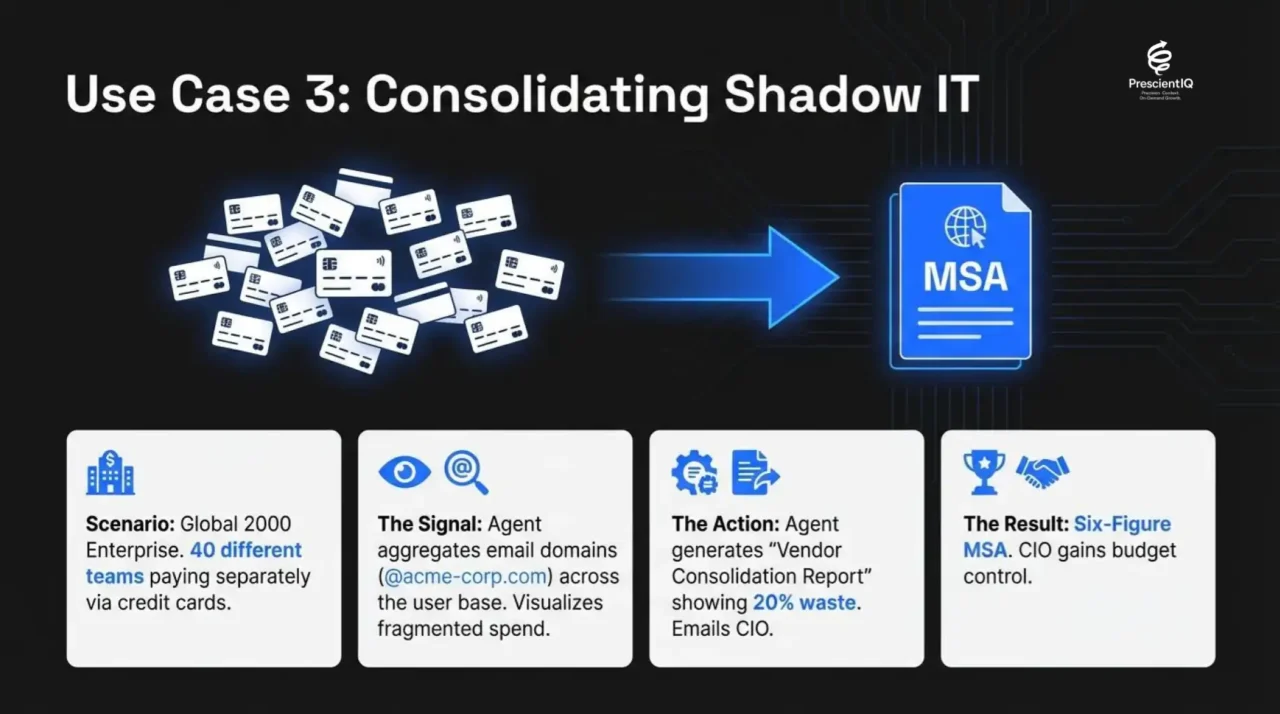
Implementing a Vertical Agentic Customer Platform for PrescientIQ and Matrix Marketing Group requires a structured transition from data-passive systems (Traditional CDPs) to goal-oriented, autonomous ecosystems.
The following implementation roadmap is designed to move your organization from “AI as a tool” to “AI as an autonomous workforce” within 90 to 180 days.
Phase 1: Foundation & “Action Gap” Analysis (Weeks 1-4)
The objective of this phase is to move from fragmented data silos to a unified, Semantic CDP that AI agents can reason across.
- Audit Workflow Bottlenecks: Conduct a comprehensive audit to identify the most time-consuming manual tasks, such as manual ad spend adjustments or lead routing, that currently limit execution speed.
- Establish the “Semantic” Data Layer: Unify CRM, behavioral, and third-party data into a “Glass-Box” system, moving beyond simple storage to a Cognitive Data Fabric that AI can interpret as context for action.
- Appoint an “Agentic Champion”: Assign a tech-forward Operations or Marketing leader to oversee the transition and ensure alignment between executive goals and technical execution.
- Define the “First Three” Use Cases: Select three specific workflows with high P&L impact—such as automated budget optimization or predictive lead scoring—to serve as initial pilot targets.
Phase 2: Use Case Selection & Strategic Simulation (Weeks 5-8)
In this phase, you utilize PrescientIQ’s core strengths in Pre-Factual Simulation to validate strategies before they are deployed autonomously.
- Deploy Pre-Factual Simulations: Use the PrescientIQ “Wargame” engine to run thousands of counterfactual scenarios (e.g., “What if we shifted 20% of the budget from Search to Social?”) to predict P&L impact before committing capital.
- Isolate Causal Drivers: Utilize the proprietary Bayesian Markov Chain Monte Carlo (MCMC) engine to move beyond correlation and identify the actual levers moving the needle in your specific vertical.
- Align with Brand Voice: Use custom LLMs trained on your specific brand guidelines to ensure that autonomous agents maintain authenticity and avoid “robotic” or generic outputs.
Phase 3: The “Human-on-the-Loop” Pilot (Weeks 9-16)
This phase introduces autonomous execution while maintaining high-touch human oversight to build trust and ensure compliance.
- Launch Agentic Pilots: Deploy specialized agents, such as a Media Buyer Agent to optimize ad bids or a Studio Agent for generative creative testing, on a small portion (5-10%) of total traffic.
- Implement the Model Context Protocol (MCP): Use open-source standards such as MCP to enable external AI agents to securely connect and correlate data across disparate enterprise applications while maintaining strict governance.
- Establish “Stop-Loss” Thresholds: Define clear boundaries and guardrails for when agents can act independently and when they must flag an exception for human intervention.
- Causal Validation: Continuously compare agent-driven outcomes against control groups using A/B testing to verify that autonomous actions are delivering the predicted ROI lift.
Phase 4: Full Scale & Autonomous Orchestration (Months 4-6+)
The final phase focuses on scaling the “Digital Workforce” and moving from task-based automation to role-based autonomous orchestration.
- Scale High-Performers: Gradually expand traffic to 50% and then full deployment for workflows that have proven stable and profitable during the pilot phase.
- Enable Agent-to-Agent (A2A) Coordination: Shift from single-agent tasks to a Hybrid Intelligence Team where multiple specialized agents (e.g., Analyst, Media Buyer, and SDR agents) work together autonomously 24/7.
- Monitor “Zero-Touch” Hygiene: Shift human roles from manual execution to orchestration, where humans monitor the overall “Nervous System” and intervene only on high-stakes strategic pivots or complex relationship management.
- Continuous GEO Optimization: Use the PrescientIQ GEO Agent to automatically restructure content into “Inverted Pyramid” formats to ensure your brand remains the top-cited entity in AI Overviews and LLM responses.
Summary of Implementation Targets
| Metric | Target Outcome | Source |
| Operational Efficiency | 60% reduction in marketing operational functions | |
| Forecasting Accuracy | 93%–97% accuracy in revenue predictions | |
| Lead Conversion | 30%–45% lift in marketing-sourced pipeline | |
| Customer Support | ~96% reduction in resolution costs ($12.00 to $0.40) |
What are the risks of using Autonomous Marketing Agents?
The risks of using Autonomous Marketing Agents include “Hallucinations,” Brand Drift, and Data Privacy concerns. If an agent is given too much autonomy without proper constraints, it might offer a discount that is too deep or use a tone that doesn’t align with the brand.
To mitigate these risks, organizations should implement:
- Human-in-the-loop (HITL): Requiring human approval for high-stakes actions.
- Strict Prompt Engineering: Defining the boundaries of the agent’s “personality.”
- Privacy-First Design: Ensuring agents comply with GDPR and CCPA by never processing PII (Personally Identifiable Information) without explicit consent.
“Trust is the most important currency in the AI era; without it, even the most efficient agent will fail,” according to IBM’s annual AI Ethics report.
Frequently Asked Questions (FAQ)
Is a Vertical Agentic Platform the same as a Chatbot?
No. While a chatbot is a communication interface, an Agentic Platform is a full-stack execution engine. A chatbot talks; an agent acts across your entire marketing ecosystem.
Do I need to replace my existing CDP?
Not necessarily. Many modern CDPs are evolving to include agentic capabilities. However, you may need to add an “Agentic Layer” on top of your existing infrastructure to handle reasoning and task execution. For more technical labs and testing environments, resources like martixlabx.com provide insights into layering these technologies.
How much does a Vertical Agentic Platform cost?
The cost varies by scale but typically ranges from $8,000 to $10,000 per month for mid-market solutions. Large enterprise implementations involving custom Vertical LLMs can exceed $100,000 annually.
McKinsey & Company: The economic potential of generative AI: The next productivity frontier.
- Gartner: Top Strategic Technology Trends for 2025/2026.
- Salesforce: State of the Connected Customer Report.
- Deloitte: AI in Marketing: The Future of Personalized Engagement.
- Matrix Marketing Group: Reinventing for Resilience: AI’s Role in B2B Growth.
- IBM: AI Ethics and the Importance of Trustworthy Systems.