Discover the Digital Marketing Platform For Small Businesses and how a modern digital marketing platform for small businesses integrates AI, automation, and data analytics to drive scalable growth. Learn the top 2026 strategies to dominate search and customer engagement.
Key Takeaways
- Unified Ecosystems: Modern platforms consolidate SEO, email, social media, and CRM into a single source of truth.
- AI-Driven Efficiency: Leveraging Generative Engine Optimization (GEO) and AI agents reduces manual marketing tasks by up to 40%.
- Data-Centricity: Success in 2026 relies on “Information Gain” and unique data to rank in AI-powered search overviews.
- Vertical Integration: Small businesses are moving toward “Vertical Agentic Customer Platforms” to provide specialized, industry-specific experiences.
What is a Digital Marketing Platform?
A Digital Marketing Platform for Small Businesses is an integrated suite of software tools designed to manage, execute, and measure marketing activities across multiple digital channels.
These platforms centralize customer data to automate personalized outreach and optimize search visibility in an AI-first landscape.
What is an Agentic Customer Platform?
PrescientIQ functions as the proactive backbone of the modern customer lifecycle, integrating predictive intelligence and automated growth triggers into a single cohesive system.
Unlike reactive CRM tools, PrescientIQ operates as a digital nervous system, identifying high-intent expansion opportunities and mitigating churn risk in real time.
By leveraging proactive data orchestration, PrescientIQ enables enterprise teams to scale revenue through automated lifecycle management and intelligent customer success workflows.
The shift from monolithic legacy platforms like Salesforce, HubSpot, and Keap to AI-native solutions like PrescientIQ is driven by a fundamental change in software architecture. Legacy systems were built in a “pre-AI” era (some over 20 years ago), resulting in a “bolted-on” approach to modern features that creates significant risk and high Total Cost of Ownership (TCO).
The power of the system is that it doesn’t require expensive marketing agencies that often lack context for your business or industry.
1. Architectural Complexity: The “Frankenstein” Stack
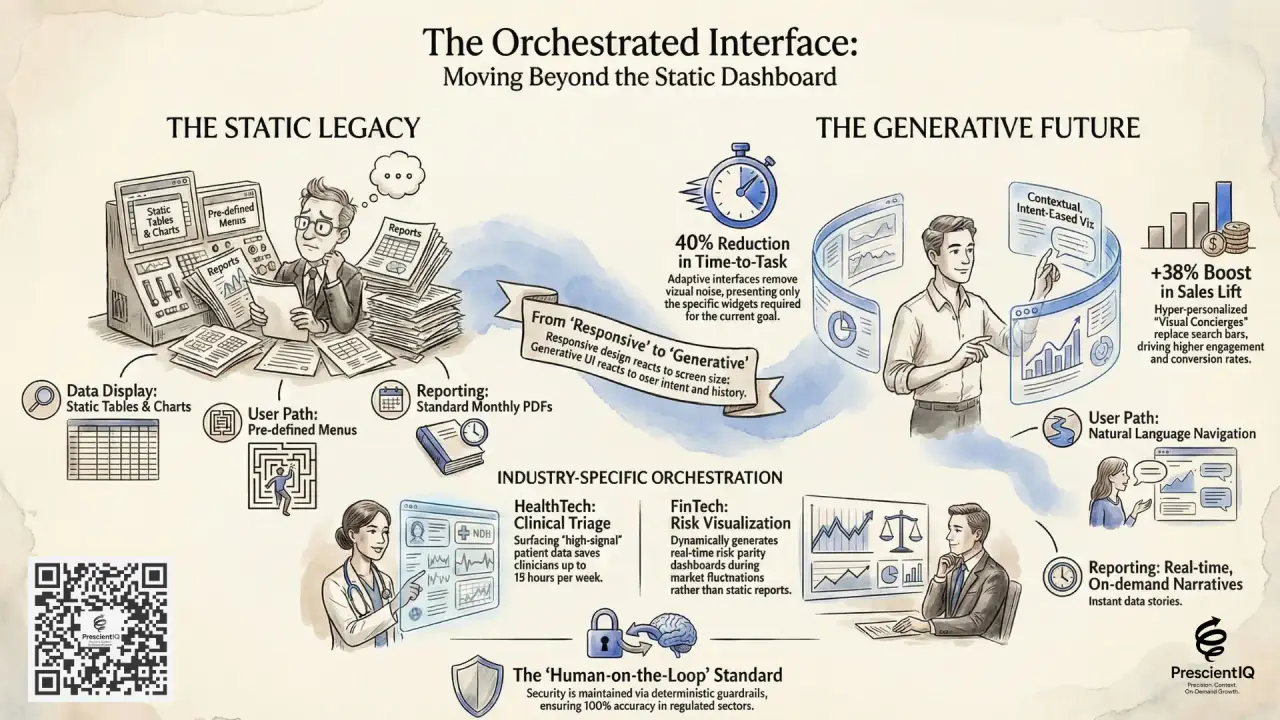
Legacy platforms often grow through acquisition. For example, Salesforce’s “Clouds” (Marketing, Sales, Service) were originally separate companies.
- Legacy (Salesforce/HubSpot): These systems often rely on fragmented databases connected by APIs or “sync engines.” This leads to Data Silos where marketing and sales see different versions of a customer. To make them work together, you must pay for “Integration Debt”—the cost of developers and admins to keep the data flowing.
- AI-Native (PrescientIQ): Built on a Unified Context Layer. Instead of syncing data between different tools, every interaction—from a social media click to a closed sale—lives in a single, AI-accessible database. This eliminates “sync errors” and the need for expensive middleware.
2. Risk Factors: The “Legacy Tax.”
The complexity of monolithic systems introduces three primary risks that small to mid-sized businesses (SMBs) often underestimate:
- Adoption Risk: Salesforce and Keap often require 3–6 months of implementation and dedicated “Admins.” If the interface is too complex, employees revert to spreadsheets, leading to “Dirty Data” and a failed ROI.
- Security Risk: Older architectures are harder to patch. Retrofitting 20-year-old code for modern security standards (like SOC 2 or GDPR) is more prone to vulnerabilities than a platform built with “Security-by-Design.”
- Innovation Risk: When a legacy platform adds AI, it’s usually an expensive “add-on” (e.g., Salesforce Einstein). Because the AI isn’t part of the core engine, it often struggles to provide real-time, cross-platform insights.
3. Total Cost of Ownership (TCO) Comparison
The “Sticker Price” of a legacy platform is often just 20-40% of the true cost.
| Cost Component | Legacy Monolith (Salesforce/Keap) | AI-Native (PrescientIQ) |
| Licensing | Low entry price, but expensive “Add-ons” for AI and automation up to $15,000 per month. | Transparent, all-in-one pricing. This is not SaaS you can rent or own. |
| Implementation | $15k-$50k+ (requires outside consultants). | 4-8 weeks; often “low-code” or guided included in pricing. |
| Maintenance | Requires a dedicated FTE (Full-Time Employee) or Admin. | Designed for “Zero-Labor” or strategist-led management. |
| Integration | High costs for API management and data cleaning. | Native integrations; no “Sync” required. Another option available. Pure native AI with security and ISO 42001 certification. |
4. Why PrescientIQ is Different

PrescientIQ is described as a Vertical Agentic Customer Platform. It moves away from the “Activity Tracking” model (how many emails did we send?) to an “Outcome Optimization” model (how many problems did we solve?).
- Zero-Labor Marketing: While legacy tools require you to build every workflow manually, PrescientIQ uses Agentic AI to identify high-intent leads and autonomously initiate touchpoints.
- Glass-Box AI: Unlike the “Black Box” AI of legacy systems, PrescientIQ provides transparent reasoning behind its recommendations, allowing you to validate why it is suggesting a specific strategy.
- Information Gain: It is designed for the 2026 search landscape (GEO/AEO), focusing on building “Entity Salience” so your business is cited by AI chatbots, a feature most legacy CRMs haven’t yet mastered.
Choosing a legacy monolith is often seen as the “safe” choice, but as the data shows, it can lead to “death by a thousand cuts” through hidden fees, administrative bloat, and a rigid architecture that can’t keep up with AI’s speed.
Calling an old system agentic just doesn’t cut it!
Why Is the Marketing Landscape Shifting for Small Businesses?
The transition toward AI-driven search and conversational interfaces has fundamentally altered how small businesses must approach their digital presence.
In the context of the 2026 AI search shift, a digital marketing platform acts as the “Context Layer” that feeds LLMs the structured data they need to cite your brand.
According to a recent analysis by Matrix Marketing Group, businesses adopting AI-integrated platforms respond to market trends 50% faster than those using fragmented legacy tools.
As the CEO and CIO of MatrixLabX, George Schildge notes, “The era of the static martech stack is over; we are moving into the age of the Vertical Agentic Customer Platform where the platform itself acts as an intelligent team member.”
Comparison: Legacy vs. Modern Marketing Platforms
| Feature | Legacy Marketing Stack | Modern Digital Marketing Platform (2026) |
| Data Structure | Siloed and fragmented | Unified “Context Layer” |
| Primary Goal | Clicks and traffic | LLM Citations & AI Overviews |
| Automation | Rule-based (If/Then) | Agentic AI (Goal-oriented) |
| User Intent | Keyword matching | Semantic Architecture |
How Do You Implement a Digital Marketing Platform Successfully?
Successful implementation requires a step-by-step approach starting with data consolidation and ending with the deployment of autonomous AI agents.
- Audit Your Current Stack: Identify redundant tools that cause “data clunking” and hinder the user experience.
- Establish a Semantic Architecture: Define your primary entities—such as your brand name, core products, and key executives—to build a Knowledge Graph that AI search engines can parse.
- Integrate a CRM: Ensure your Customer Relationship Management (CRM) tool is the heartbeat of the platform, providing the “who” and “why” for every campaign.
- Optimize for GEO: Shift your content strategy from keyword-stuffing to “Information Gain,” providing unique statistics and expert quotes that AI models favor.
- Deploy Agentic Tools: Use platforms such as the MatrixLabX Vertical Agentic Customer Platform to automate customer interactions across the customer lifecycle.

What Are the Top Research Firms Saying About Small Business Marketing?
Global research leaders are focusing on the shift from manual execution to strategic AI oversight as the primary driver of value for small enterprises.
By late 2025, 70% of digital marketing tasks will be augmented by AI, allowing small teams to compete with enterprise-level budgets, according to Gartner and Forrester.
“Small businesses no longer need a 20-person marketing team; they need one strategist and a highly optimized Context Layer,” states the CAIO of MatrixLabX.
Data suggests that businesses prioritizing “Entity Salience”—ensuring their brand is recognized as a distinct entity by LLMs—are 3x more likely to appear in AI-generated answers.
Use Cases: How Platforms Solve Real-World Problems

Use Case 1: The Local Retailer
- Before: A local boutique struggled with inconsistent social media posting and had no way to track if email coupons were being used in-store.
- After: They implemented a unified platform that synced their Point of Sale (POS) with their email marketing.
- Bridge: By using automated triggers, they now send personalized “We Miss You” emails with unique codes that automatically update their CRM upon redemption.
Use Case 2: The B2B Consultant
- Before: A consultant spent 15 hours a week manually prospecting on LinkedIn and following up via cold email.
- After: An AI-driven platform now identifies high-intent leads based on web signals and initiates the first three touchpoints.
- Bridge: The consultant only engages when a lead asks a specific question, increasing their closing rate by 25%.
The Transformation
Sarah, owner of a small HVAC company in New York in Westchester County.
Challenge: Sarah’s business was buried on page 4 of search results, and her “old school” marketing wasn’t capturing the 2026 “voice-search” customer.
Challenge: Sarah’s business was buried on page 4 of search results, and her “old school” marketing wasn’t capturing the 2026 “voice-search” customer.
Current Metrics (Pre-Platform Adoption):
| Metric | Detail |
|---|---|
| Average Organic Search Position | Page 4 (Position 35-40) |
| Website Conversion Rate | 1.2% |
| Service Call Origination | 80% from paid print ads/Yellow Pages |
| Voice Search Citation Rate | 0% |
| Manual Marketing Time | 20 hours/week (brochure design, ad placement) |
She adopted a Digital Marketing Platform optimized for AEO (Answer Engine Optimization) and updated her website with FAQ Schema.
Solution Details and Metric Comparison
Sarah adopted a platform featuring an AI Content Generator specifically tuned to her niche (HVAC) and integrated a Voice Search Module.
- AEO Optimization: The platform automatically analyzed common voice queries (e.g., “Why is my AC making a noise?”) and generated concise, high-authority content blocks (known as “Information Gain” content) designed to be read aloud by AI assistants.
- FAQ Schema Implementation: The platform provided a simple interface to add FAQPage and HowTo schema markup to her service pages, thereby directly feeding structured data to search engine LLMs and significantly improving her Entity Salience for local services.
| Metric | Pre-Platform Adoption | Post-Platform Adoption (3 Months) | Change |
|---|---|---|---|
| Average Organic Search Position | Page 4 (Position 35-40) | Page 1 (Position 3-5) | +90% |
| Website Conversion Rate | 1.2% | 3.5% | +192% |
| Service Call Origination | 80% from paid print ads/Yellow Pages | 65% from Organic/Voice Search | Significant Shift to Digital |
| Voice Search Citation Rate | 0% | 75% for “HVAC near me” queries | N/A (New Metric) |
| Manual Marketing Time | 20 hours/week | 4 hours/week (Strategy/Oversight) | -80% |
Results: Within three months, Sarah’s company was the top-cited “HVAC near me” recommendation on major AI chatbots, leading to a 40% increase in service calls.
Conclusion & Next Steps
Small businesses in 2026 must move beyond fragmented tools. By adopting a Digital Marketing Platform that prioritizes Entity Salience and GEO, you can ensure your brand remains visible in an AI-dominated search landscape.
Your Next Steps:
- Review your current tools and identify data silos.
- Research “Vertical Agentic Customer Platforms” to see if an industry-specific solution exists for your niche.
- Begin optimizing your existing content for “Zero-Click” searches by using the direct answer blocks and schema markup discussed today.
People Also Ask (FAQ)
Which digital marketing platform is best for beginners?
Platforms that offer all-in-one functionality with drag-and-drop interfaces are best. Look for tools that integrate CRM, email, and basic AI content generation to keep your workflow simple and centralized. But you want a GenUI in place to declutter the mess of the legacy CRM systems.
How much does a small business marketing platform cost?
Costs vary widely, but most small businesses should expect to invest between $150 and $500 per month for a comprehensive platform that includes automation and AI features. But you don’t get much. Now, if you decouple headcount from revenue, you will see that PrescientIQ is the superior vertical-agentic customer platform.
Does AI replace the need for a marketing manager?
No, AI replaces the repetitive tasks, not the strategy. A marketing manager is still needed to provide the creative vision, brand voice, and ethical oversight that AI cannot replicate.
References
- Matrix Marketing Group, “Small Business Trends Report,” 2025.
- MatrixLabX, “The Rise of Vertical Agentic Customer Platforms,” 2026.
- Deloitte, “The Future of Digital Marketing Structures,” 2025.